


If you just found out about unpermitted work on your property — whether from a buyer’s inspection, a city letter, or your own research — you have options. You can sell a house with unpermitted work in California. Unpermitted work does not void your ability to sell, but it does affect your options and your buyer pool. Traditional buyers using bank financing will run into problems — lenders may not fund a home with known unpermitted work or code violations. Some homeowners skip the permit process entirely to save time, but this creates real complications when it’s time to sell — especially with lenders and appraisals. Your options are to disclose and sell as-is, pursue retroactive permits, redo the work correctly, or sell directly to a cash buyer who specializes in distressed properties. Quick Home Offers® has been purchasing homes with unpermitted work throughout California since 2013.
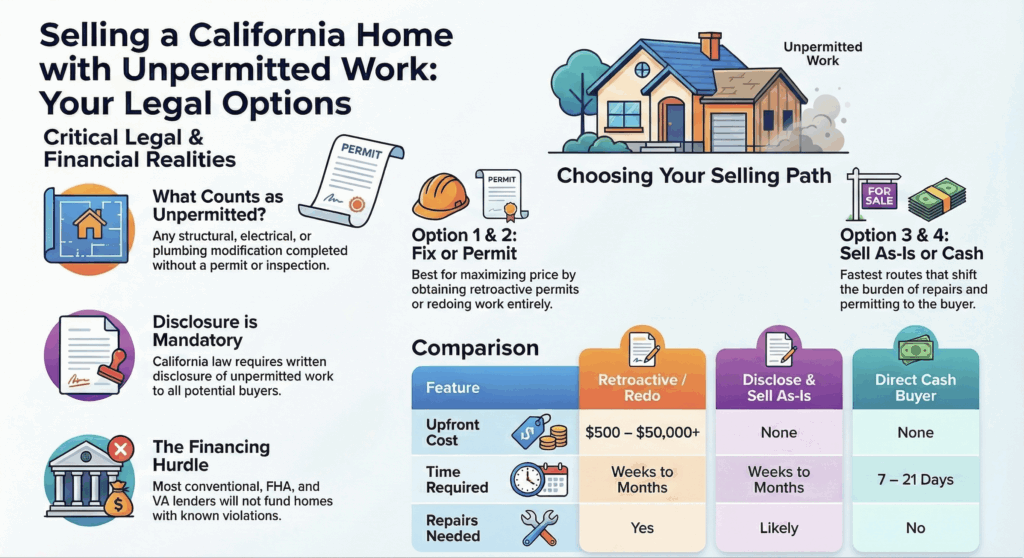
Selling a House With Unpermitted Work in California – Quick Answer
Yes, you can sell a house with unpermitted work in California, but you are legally required to disclose it. Unpermitted work does not prevent a sale, but it limits your buyer pool because most lenders will not finance a home with known permit issues. Your options are to disclose and sell as-is on the open market, apply for retroactive permits if the work meets current building code, redo the work with proper permits to maximize sale price, or sell directly to a cash buyer who purchases the property as-is with no permits or repairs required. The right choice depends on the type of work, your timeline, and whether you are currently facing code enforcement fines.
What This Guide Covers
What Counts as Unpermitted Work in California?
What Happens If You Rent Out an Unpermitted Unit in California?
How to Find Out if Your Home Has Unpermitted Work
What to Expect When You Call the Building Department
Unpermitted Work vs. Code Violations
California Cities That Require Presale Inspections or Building Reports
Your Options for Selling a House With Unpermitted Work
Which Option Is Right For You?
How Quick Home Offers Handles Unpermitted Work
What Counts as Unpermitted Work In California?
Unpermitted work is any modification to a home’s structure, electrical, plumbing, or mechanical systems that was completed without a building permit or without passing required inspections. Common examples in California include garage conversions, room additions, ADUs, electrical panel upgrades, plumbing reroutes and plumbing work, HVAC installations, finished basements (common in other states), patio enclosures, adding a new bathroom, and converted carports. These types of unpermitted renovations and unpermitted improvements are more common than most sellers expect. In California, building permits are required any time construction affects the structure or essential systems of a home — regardless of who did the work or when it was done.
We have sold two properties to Quick Home Offers this year…
We have sold two properties to Quick Home Offers this year, dealing mostly with Adam Justiniano. Adam is very professional and made the entire process smooth both times.
Dealing with unpermitted work or code violations on your California home?
We’ll Call You Within 1 Business Day
No fees. No obligation. Serving California since 2013.
How to Find Out if Your Home Has Unpermitted Work
If you’re not sure whether work on your property was properly permitted, there are a few ways to check before it becomes a problem during a sale.
Start with your local building department’s permit records. Most California cities and counties let you search by address online. Before calling anyone, spend a few minutes online researching your area’s permitting requirements, enforcement policies, and what options exist for resolving unpermitted construction.
Dozens of California cities and counties use Accela Citizen Access portals for permit searches. You can search building permits by address or parcel number, usually for free. Cities and counties that run Accela portals include Santa Barbara (city and county), Ventura County, Kern County, Sacramento (city and county), and Fresno (city and county), among many others. The City of Bakersfield runs its own system through Click2Gov. If you’re not sure what your area uses, search “[your city or county] building permit search” or “[your city or county] Citizen Access” and you’ll usually find the right portal. For a statewide overview of permitting requirements, visit the HCD.ca.gov website here.
You can also check the original blueprints if you have them. They’re sometimes in your closing documents from when you bought the property. Compare the original layout to what’s there now. Any structural changes that don’t match the plans were either permitted separately (and should show up in the city’s records) or weren’t permitted at all.
What to expect when calling the building department
If you decide to pursue retroactive permits, your first step is calling or visiting your local building department. Here’s what to expect so you’re not caught off guard.
Most building departments will ask for the property address and pull up the permit history on file. They’ll want to know what work was done, when it was done, and whether you did it yourself or hired a contractor. Be honest — they’ve heard it all, and volunteering the information upfront is better than having them discover it during an inspection.
From there, the building department will typically tell you what’s needed to bring the work into compliance: updated plans, engineering reports, contractor involvement, or specific inspections. Some cities will schedule a preliminary inspection to assess the scope before requiring formal plans. Others will want plans submitted first.
Timelines vary widely. A simple retroactive permit for a water heater or basic electrical work might be resolved in 2–4 weeks. A garage conversion or room addition could take 2–6 months, depending on the city’s backlog, the complexity of the work, and whether corrective construction is needed. Fees range from a few hundred dollars for minor items to several thousand for structural work — and some cities charge penalty fees for work done without permits, which can double the standard permit cost.
The key thing to know: calling the building department does not automatically trigger fines or enforcement action in most cities. You’re voluntarily coming forward to resolve the issue, and most departments treat that differently from a complaint-driven investigation. That said, once the city knows about the unpermitted work, you’re on their radar — so don’t call unless you’re ready to follow through.
Pull up whatever you find and compare it against what’s actually in your home. If there’s a converted garage, an added bathroom, or a finished patio cover that doesn’t show up in the permit history, that’s a red flag.
If you’re still not sure, a licensed home inspector can usually spot unpermitted work during a walkthrough. They’ll notice things like mismatched construction quality, electrical panels that don’t match the home’s age, or plumbing that doesn’t follow typical routing. It’s worth the few hundred dollars to know what you’re dealing with before a buyer’s inspector finds it for you.
What Happens If You Rent Out an Unpermitted Unit in California?
If you own a rental property where one or more units were built or converted without permits — a garage turned into a studio, a room addition used as a separate rental, an unpermitted ADU — the legal exposure is more serious than most landlords realize. Under California law, an unpermitted unit — sometimes called an illegal unit or unwarranted unit — carries liability that can follow you for years.
The Lease Is Void If the Unit Is Illegal
Under California case law, a lease for an illegal unit is considered void. The landmark case is Gruzen v. Henry (1978) 84 Cal.App.3d 515, where the court ruled that a landlord is not entitled to collect or request rent for a unit that lacks a certificate of occupancy. The lease itself is treated as an illegal contract.
A later case, Carter v. Cohen (2010) 188 Cal. App.4th 1038, went further: while the landlord cannot enforce the lease, the tenant can. This means a tenant living in an unpermitted unit can sue the landlord for damages — including full recovery of every dollar of rent paid — going back to the beginning of the tenancy.
What the Tenant Can Sue For If They Are Occupying An Unpermitted Unit In California
A tenant in an unpermitted or illegal unit may have grounds to pursue several claims, depending on the specifics of the situation and the local jurisdiction. These can include recovery of all rent paid during the tenancy, relocation assistance (required in many California cities before a landlord can evict a tenant from an illegal unit), attorney fees, and additional damages for habitability violations, fraud, or misrepresentation if the landlord knew the unit was unpermitted and rented it anyway.
In rent-controlled cities — including Los Angeles, San Francisco, Berkeley, and Oakland — tenants in unpermitted units are still covered by rent control ordinances and just-cause eviction protections. The landlord cannot raise rent beyond the allowable annual increase, and the tenant cannot be evicted without a valid legal reason under the local ordinance, even though the unit itself is not legally permitted.
Insurance May Not Cover You With An Occupied Unpermitted Unit
Most standard landlord insurance policies exclude coverage for incidents occurring in unpermitted structures. If a tenant is injured in an unpermitted unit — a fire caused by substandard electrical, a fall on unpermitted stairs, a health issue from inadequate ventilation — the landlord may have no insurance protection and could be personally liable for the full cost of the claim.
How A Rented Illegal Unit Affects a Property Sale
If you are selling a property with an occupied unpermitted unit, you are selling a property with active legal exposure. Every month the unit remains rented, the potential liability grows. A buyer — whether conventional or cash — will factor this risk into their offer.
For sellers, the key question is whether to address the unit before selling or sell the property as-is to a buyer who understands the situation and can handle the compliance, the tenant, and the permitting after closing.
We purchased a six-unit building in Bakersfield, where one of the units was completely unpermitted and occupied by a paying tenant. The seller was carrying exactly this kind of exposure — a void lease, potential rent recovery liability, and no insurance coverage on the unpermitted unit. Quick Home Offers® bought the building as-is, took on the compliance work, and handled the tenant situation so the seller could walk away clean.
If you own a rental property with an unpermitted unit and you are thinking about selling, this is a conversation worth having sooner rather than later. Call or text us at (805) 870-5749.
Quick Home Offers® is not a law firm, and this is not legal advice. If you believe you have a legal issue involving an unpermitted rental unit, consult a California real estate attorney or tenant law attorney for guidance specific to your situation.
What About Open Permits?
Open permits are different from unpermitted work. An open permit means someone pulled a permit for work on the property, but never scheduled the final inspection or never received a sign-off from the building department.
The permit is still “open” in the city’s system. In our experience, open permits typically add 2-4 weeks to a traditional sale while you get them closed — and that’s if the work passes inspection on the first try. If the work does not pass inspection the first time around (which is not unusual), you’re looking at 4-6 weeks, on average.
Expired permits are similar but can be worse in some cases. Most California building departments set a time limit on permits — typically 6 to 12 months from the date of issuance. If the work was not completed and inspected within that window, the permit expires. At that point, the homeowner may need to apply for a new permit entirely, which can mean paying new fees, submitting updated plans, and meeting current building codes that may have changed since the original permit was issued.
Both open and expired permits can create the same problems as unpermitted work when it comes time to sell. Lenders may flag them during the title or escrow process, and many will not fund a loan until the permits are resolved. Closing an open permit usually means scheduling a final inspection with the building department. If the work passes, the permit gets closed, and you are clear. If it does not pass, you may need to make corrections before the city will sign off. Expired permits typically require starting the entire permitting process over. Requirements vary by city or county, so it’s important to check with your local building department for specific steps.
If you inherited a property or bought a home without realizing there were open permits from a previous owner, you are not alone. This comes up regularly in our transactions. You can either close the permits yourself or sell to a cash buyer who will handle them after closing. Call your local building department to understand what needs to be done to close out the permits.
Unpermitted Work vs. Code Violations
Unpermitted work and code violations are related, but they are not the same thing. Unpermitted work means a modification was made to the property without pulling a building permit. Code violations mean the property has been cited by the city or county for not meeting current building or safety standards.
Unpermitted work can lead to code violations and fines, but a property can have unpermitted work without any code violations. For example, a homeowner converts a garage without a permit, but no one from the city has flagged it. A property can also have code violations without unpermitted work — an older home may have been built to code at the time, but no longer meets current standards.
Where it gets complicated is when unpermitted work triggers a code violation.If the city discovers unpermitted construction during an inspection or complaint, the city can issue fines, require corrections, and place a code enforcement lien on the property. To resolve these issues, the city may require you to bring the work up to current codes and ensure full code compliance before removing the lien. Failing to address these requirements can expose you to legal risks, including lawsuits or penalties if problems are found after a sale. That lien stays on the title and has to be dealt with before or during a sale. For any conventional sale, this lien must be dealt with and removed prior to selling.
California Cities That Require Presale Inspections or Building Reports
If your property is in one of these cities and you have unpermitted work, the presale report will likely flag it. In cities that require a physical inspection, a city employee will visit the property and note anything that doesn’t match the permit records. In cities that only require a building records report, the missing permits will be obvious when the city’s file doesn’t match what’s actually on the property.
This doesn’t necessarily kill your sale — but it can slow it down. In a traditional sale, the buyer’s lender may refuse to fund the loan until the issues are resolved. That puts the burden on you, the seller, to fix the work or obtain permits before you can close.
When Quick Home Offers® purchases a property in a city with presale requirements, we still complete the required report — that step can’t be skipped. The difference is that in many of these cities, the buyer can acknowledge the findings and take responsibility for corrections after closing. That’s exactly what we do. We close on the property knowing what’s there, and we handle the permits, repairs, and city compliance on our end after the sale is complete. The seller doesn’t have to fix anything before closing.
| City | What’s Required | Physical Inspection? |
|---|---|---|
| Azusa | Real Property Records Report | Yes |
| Bell | Pre-Sale Report | Yes |
| Beverly Hills | Sale of Property Affidavit | No |
| Burbank | Retrofit Upon Sale Certificate of Compliance | No |
| Carpinteria | No Longer Required | No |
| Compton | Pre-Sale Inspection Report | Yes |
| Cudahy | Pre-Inspection Report | Yes |
| Culver City | Report for Residential Building Record | No |
| Gardena | Property Information Report | Yes |
| Hawaiian Gardens | Pre-Sale Inspection Report | Yes |
| Hermosa Beach | Report for Residential Building Record | No |
| Huntington Park | Presale Records and Inspection Report | Yes |
| Inglewood | Pre-Sale Report | Yes |
| Laguna Beach | Real Property Report | No |
| Lawndale | Residential Property Report | Yes |
| Long Beach | Garage Inspection Report | Yes |
| Los Angeles | 9A Residential Property Report | No |
| Lynwood | Real Property Report | Yes |
| Manhattan Beach | Residential Building Report | Yes |
| Maywood | Pre-Sale Report | Yes |
| Newport Beach | No Longer Required (Optional) | No |
| Oxnard | Not Currently Required — Check With City | No |
| Palos Verdes Estates | Real Property Records Report | No |
| Pasadena | Presale Certificate of Completion or Inspection | Yes |
| Port Hueneme | Residential & Commercial Building Records | No |
| Redondo Beach | Report of Residential Building Records | No |
| Rolling Hills Estates | Pre-Sale Inspection Report | Yes |
| San Marino | Residential Compliance Certificate | No |
| Santa Monica | Residential Building Report | No |
| South Gate | Pre-Sale Inspection | Yes |
| Thousand Oaks | No Longer Required | No |
| Torrance | Smoke Detector Certificate of Compliance | No |
| Ventura | Building Records Disclosure Report | No |
Fees and requirements change periodically. Contact your local building department for current information.
For a statewide reference, see this presale inspection list from WFG National Title.
Your Options for Selling a House With Unpermitted Work in California
Homeowners with unpermitted work have four realistic paths. The right choice depends on your situation, timeline, severity of the work, if you’re currently being fined by the city or county, and how much you’re willing to spend before selling.
Before choosing, understand that the permit process and requirements vary depending on your local building permit office. If you decide to address the work, you may need to obtain permits retroactively or redo the construction entirely.
Option 1: Disclose and Sell As-Is
In California, full disclosure is legally required when selling a house with unpermitted work, and the seller is aware of the issue. Sellers must provide a disclosure statement that includes any unpermitted work to avoid liability. Selling a house as is means offering the property in its current condition, including any unpermitted construction.
This approach often raises buyer concerns, as potential buyers may worry about legal risks, future costs, and financing challenges. As a result, sellers commonly adjust the price downward to reflect the unpermitted work, since appraisers typically do not include unpermitted areas in their valuations. Buyers typically expect a discount for homes with unpermitted work — especially when the unpermitted areas can’t be counted toward the home’s appraised square footage.
Certain unpermitted work may limit your buyer pool to cash buyers willing to take on the permitting process themselves. If the work involves room additions, electrical panels, major plumbing repairs, or structural changes such as removing walls, it can pose issues for lenders and prospective traditional buyers. If the items are simple, such as an unpermitted outlet or a breaker repair, you will likely not have issues
Option 2: Pursue Retroactive Permits
In some cases, the unpermitted work can be permitted after the fact. You will need to make sure the work complies with the current building code. If the work was done to code at the time, this may not matter, and you may need to do additional work to bring it up to today’s building code.
Contact the local building department to see what’s involved. This route works best when the unpermitted work is simple, like a roof, deck, fence, or very simple addition.
This may not be a great path if it’s more involved work like structural, electrical, plumbing systems, etc., that will require opening walls or the subfloor for inspection.
Depending on your city and the scope of work, retroactive permits typically cost $500 to $5,000 in fees alone — not counting any corrective construction if it’s required to meet current codes.
Option 3: Redo the Work With Proper Permits
If retroactive permits are not possible, your next option is to have the work completely redone correctly by a licensed contractor who will pull permits, redo the work, and call for inspections.
This is by far the most expensive path, but it adds the most value to your home or property. Make certain to get multiple bids, and compare the cost to cure vs the value added. It also helps to compare to your other options, such as selling as-is.
Option 4: Sell Directly to a Cash Buyer
If you don’t want to spend time or money on permits or repairs, selling directly to a cash buyer is your fastest and most straightforward option. Cash buyers like Quick Home Offers® purchase homes with unpermitted work as-is throughout California — no repairs required, no permits required, no agent commissions.
The offer will reflect the property’s current condition, but when you factor in what you’re not spending on repairs, permits, and carrying costs, the net difference is often smaller than expected.
We’ll Call You Within 1 Business Day
Enter your number. We’ll walk through your options — whether you sell to us or not. No fees. No obligation. Serving California since 2013.
Quick Home Offers® has been purchasing homes with unpermitted work throughout California since 2013. Call (805) 870-5749 for a direct conversation with no obligation.
Which Option Is Right For You?
| Disclose & Sell As-Is | Retroactive Permits | Redo the Work | Cash Buyer | |
| Upfront Cost | None | $500–$5,000+ | $10,000–$50,000+ | None |
| Time Required | Weeks to months | Weeks to months | Months | 7–21 days |
| Conventional Buyer OK | Possibly – depends on the buyer’s lender | Yes — if approved | Yes | None needed – cash only |
| Repairs Required | Buyers may still ask for repairs, even if selling as-is. | Possibly | Yes | No |
| Agent Commission | 5–6% if using the agent | 5–6% if using agent | 5–6% if using agent | None |
| Closing & Title Costs | 1–2% of the sale price | 1–2% of the sale price | 1–2% of the sale price | None — we pay escrow |
| Holding Costs | Moderate — weeks of mortgage, taxes, insurance | Moderate — weeks of mortgage, taxes, insurance | High — months of mortgage, taxes, insurance | Minimal — closes fast |
| Best For | Unpermitted work that is minimal | Work done correctly or minor permits | Maximize sale price | Easy as-is fast sale; lowest cost to seller |
How Quick Home Offers® Can Help
Unpermitted work is far more common than most homeowners realize — especially in older California homes where previous owners made changes over decades without pulling permits. This can complicate the selling process and, if not properly disclosed, may limit a seller’s legal recourse if issues arise after the sale.
When we purchase a property with unpermitted work, we take on the full responsibility of resolving it after closing. That means the seller does not need to hire contractors, pull permits, schedule inspections, or negotiate with the building department. We handle all of it.
We evaluate the scope of the unpermitted work and determine whether retroactive permits are feasible or whether the work needs to be redone. Adam coordinates directly with the seller throughout the transaction to make sure the timeline works and there are no surprises. We have purchased homes with converted garages, un-inspected electrical panels, unpermitted room additions, expired permits from previous owners, and properties under active code enforcement with accruing fines.
If you are dealing with unpermitted work on your California property and want to understand your options, call us at (805) 870-5749.
There is no obligation and no pressure. We will walk you through what we see and what makes sense for your situation.
Here’s an unpermitted project we helped the seller get rid of:
We purchased a six-unit apartment building in Bakersfield that had an unpermitted unit, unpermitted electrical work, and an active code violation lien from the city. The seller had been dealing with the city and was unsure whether they could even sell with the violations unresolved. This particular seller did not have the funds to do the work needed to resolve the issues. We did the research upfront, worked with the city to understand exactly what was on the property, and gave the seller the information they needed to make the best decision for their situation.
We closed on the property in about 20 days with the code violation lien still attached, and took on the responsibility of resolving the violations ourselves.
The seller did not have to fix anything, pull any permits, or clear the lien before closing.
Here is what working with us looks like:
- No repairs required. We buy the property exactly as it sits — unpermitted work and all.
- No fees or commissions. We are not real estate agents. We pay our own escrow fees.
- Fast close. We can close in as little as 7 days once we are in agreement — no bank financing delays.
- No permit requirements. We do not require you to pull permits or fix anything before closing.
- Honest offer. Every offer is personally evaluated by Adam or Josh based on your specific property — not generated by an algorithm.
A lot of sellers with unpermitted work are worried they won’t be able to sell or that they’ll face legal trouble. If you own a home in California with unpermitted work and want a straight answer from a real buyer, call us directly at (805) 870-5749 or submit your address below. There is no obligation and no judgment — we have seen every situation imaginable since 2013.
Frequently Asked Questions — Unpermitted Work in California
Q: Do I have to disclose unpermitted work when selling in California?
A: Yes. California law requires sellers to disclose known material facts that affect the value or habitability of the property. Unpermitted work is a material fact and must be disclosed to any prospective buyer, regardless of how you sell. Failure to disclose creates legal liability that follows you after the sale closes.
Q: Can a tenant sue me for renting an unpermitted unit in California?
Yes. Under California case law, a lease for an unpermitted unit is considered void. In Gruzen v. Henry (1978), the court ruled that a landlord cannot legally collect or request rent for a unit without a certificate of occupancy. In Carter v. Cohen (2010), the court ruled that while the landlord cannot enforce the lease, the tenant can — meaning the tenant can sue for full recovery of all rent paid during the tenancy, plus relocation assistance, attorney fees, and additional damages. In rent-controlled cities, tenants in unpermitted units are also protected by local rent ordinances and just-cause eviction rules. If you own a rental property with an unpermitted unit and are considering selling, call Quick Home Offers at (805) 870-5749 for a no-obligation conversation about your options.
Q: Can a house with unpermitted get a mortgage?
A: It depends on the type and extent of the work, but in most cases, it creates issues. FHA appraisal guidelines under HUD Handbook 4000.1 require that properties meet minimum property standards for safety, security, and structural soundness. Unpermitted square footage typically cannot be included in the home’s appraised gross living area, which lowers the valuation.
If the unpermitted work is considered an illegal use under local zoning, the property is not eligible for FHA mortgage insurance. Most conventional lenders and VA lenders apply similar standards.
If there have been major modifications such as removing structural walls, plumbing system updates, electrical panel changes, garage conversions, or unpermitted ADUs, it means buyers using any conventional form of financing will have difficulty closing on a home with known unpermitted work. This may narrow your buyer pool to cash buyers.
Q: How much does it cost to fix unpermitted work in California?
A: It depends on the type and scope of work. Retroactive permits — where the existing work meets current building codes — typically cost $500 to $5,000 in permit fees. If the work needs to be redone with proper permits and inspections, costs can range from $10,000 to $100,000+, depending on the extent of construction involved. Get estimates from a licensed contractor before committing to either path.
Q: Can I sell a house with open or expired permits in California?
A: Yes. Open permits mean work was started, but the work never received a final inspection. Expired permits mean the permit window closed before the work was completed or signed off. Both can block conventional financing and delay a traditional sale. You can resolve the permits through your local building department, or you can sell to a cash buyer who will handle them after closing.
Q: What happens if I sell a house without disclosing unpermitted work?
A: Failing to disclose known unpermitted work in CA exposes you to serious legal liability, including lawsuits, rescission of the sale, and damages. California courts have consistently held the parties responsible for non-disclosure of material defects. Always disclose everything in writing to cover yourself.
Q: Can unpermitted work be permitted after the fact in California?
A: Sometimes. If the work was done correctly and meets the current building code, a local building inspector may approve it retroactively. The process, cost, and timeline vary significantly by city and county. Contact your local building department to understand what is involved, the timeline, and estimated permit costs before assuming retroactive permits are possible.
Q: How does unpermitted work affect the value of my home?
A: Unpermitted work reduces your effective buyer pool and typically results in lower offers from buyers who factor in the cost and risk of resolving the permits. The discount varies depending on the type and extent of the unpermitted work. An unpermitted garage conversion carries more risk than an unpermitted patio cover or deck.
Q: Will Quick Home Offers® buy a house with unpermitted work?
A: Yes. Quick Home Offers® purchases homes with unpermitted work throughout California as-is. We do not require repairs, permits, or inspections before closing. We have purchased homes with unpermitted additions, garage conversions, ADUs, electrical upgrades, and more. Call (805) 870-5749 or submit your address for a no-obligation cash offer.
About the Authors

Adam Justiniano is co-owner of Quick Home Offers® and works directly with sellers across California. He personally evaluates every property the company considers purchasing, including homes with unpermitted additions, converted garages, un-inspected electrical work, and active code enforcement cases. Adam has been buying real estate since 2013 and has closed transactions on properties that other buyers and agents walked away from due to permit complications. He grew up in Ventura County and still lives there today.

Josh Justiniano is co-owner of Quick Home Offers® and handles the company’s underwriting and project management. On properties with unpermitted work, Josh evaluates the cost to cure, determines whether retroactive permits are feasible, and manages the renovation and permitting process after the company acquires the property. He worked at a legal firm in Thousand Oaks before entering real estate at 21. He went to CSUN and majored in real estate. He and Adam have closed over 300 property purchases across California since 2013.
Quick Home Offers® is a California cash home buying company headquartered in Thousand Oaks, CA. The company purchases houses, condos, multifamily properties, and land statewide, including properties with unpermitted work, open permits, and code violations. Every offer is personally evaluated by Adam or Josh, not generated by an algorithm. To speak with them directly, call (805) 870-5749.